
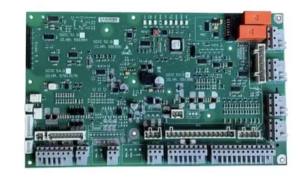
When a variety of elevator electronic board in the normal use of the case of failure, generally due to damage to individual components in the electronic board, the chances of damage to the core components are generally relatively small. As the microprocessor (CPU), memory: EPROM, RAM, crystal, etc. are in 5V or lower voltage, small current conditions, the chances of failure are very small, the general failure is out of the I / O interface part and the power supply part.
In preparation for elevator circuit board repair, we must first ask in detail about the failure phenomenon, to understand the role of the relevant interfaces, which can shorten the time required to determine the fault. Elevator circuit board repair should be careful, not careless, in the absence of understanding the role of the signal, it is strictly prohibited to short-circuit signals, in order to avoid the expansion of the fault. In the elevator circuit board repair, generally need to operate according to the following methods:
1 The use of the main control circuit board power-up process, the initial judgment of the microprocessor, memory, software failure. Methods: the use of initialization operations to judge, the simplest way is to check whether the output relay suction, LE display is normal, there is no error sound, etc.. If there is an alarm sound, digital or character display, through the judgment of the above content, generally can judge the microprocessor, memory, software system whether there is a hard failure. If the results of the judgment is not normal, we must check the main control circuit board external input voltage is normal, whether the current is normal; after confirming that the power supply is normal, you can check whether the CPU voltage is normal (generally 5V), whether the reset circuit is normal, whether the oscillator circuit is normal and so on.
A related person engaged in elevator work for many years, said many of the main control circuit board failure is caused by the reset circuit protection. Reset circuit protection is generally due to its supply voltage is low, thus causing the watchdog circuit intermittent action or hold action. Special reminder here, the supply voltage refers to the input power supply through the rectifier circuit, voltage regulator circuit, filter circuit; power supply monitoring circuit after the CPU and other core modules directly use the voltage, not the external input voltage. The precision requirements of this voltage is relatively high, the power supply of the CPU and other circuits can not be lower than 4.6V, the supply of the watchdog voltage can not be lower than 5V.
2 The method of elevator circuit board maintenance when there is no reflection after inputting the signal: first of all, we should confirm whether the power supply is normal, and determine whether the CPU is working normally. Encountering this kind of failure generally check the input circuit interface part, check whether the protection diode, current limiting resistor is broken, optical coupling, isolation transformer is normal. Optocoupler in the circuit, the latch circuit is basically not damaged. Judgment can be photocoupler as a demarcation line, to determine the fault in the optical coupling in front of the circuit part of the circuit part of the back.
Judgment method: directly to the photocoupler input rated voltage input, so that the photocoupler is in the working state, and then check whether the electronic board has the corresponding reflection, if there is a reflection, it can be judged as the photocoupler before the circuit has a problem. If there is no corresponding reflection, a 5V voltage can be used to connect a 470-ohm resistor directly into the output of the optical coupler, and then check whether the electronic board has a corresponding reflection.
3 circuit board repair no output signal repair method: first confirm whether the power supply is normal, to determine whether the CPU is working properly, check whether the corresponding input signal is normal. In the above are confirmed to be normal, and then check the output interface of the power amplifier interface circuit, power element drive circuit, signal isolation circuit (optical coupling or transformer), signal latch circuit

 English